Etsy Attributes Explained: The Details That Work Like Tags
What Etsy listing attributes are, why they count like tags, how your category decides which ones you get, and how to fill them in without guessing.
By HolgoPublished Updated
Below the category box on an Etsy listing sits a set of dropdowns most sellers click past: materials, capacity, occasion, holiday and more, depending on what you sell. They look optional, and most of them are. They are also some of the most useful words in your listing, because Etsy reads them the way it reads your tags.
This guide covers what attributes are, how your category decides which ones you get, and how to fill them in honestly.
What attributes are
Attributes are the fixed-choice details of a listing. A tag is anything you type; an attribute is picked from a list Etsy gives you for that kind of item. Stoneware chosen from the Materials list is an attribute; speckled stoneware mug typed in the tag field is a tag.
Etsy's seller handbook describes attributes as limited and category-specific, and says they power the filters in the sidebar of search results, such as color, holiday or occasion. It is blunt about what that means: the only way for a listing to appear in filtered results is if it has that attribute.
Attributes work like tags
This is the part Etsy states plainly in its Keywords 101 guide: categories and attributes act like tags. The words in them count toward what your listing can be found for.
That has two consequences:
- Fill in every attribute that is true. Each one is a set of search words you get without spending a tag.
- Don't spend tags repeating them. If Stoneware is already your material, a tag that only says stoneware adds nothing. A longer phrase that builds on it, like speckled stoneware mug, still earns its slot. Our guide to Etsy tags covers this in more detail.
Your category decides which attributes you get
There is no single attribute list on Etsy. The options appear after you choose a category, and they change with it. Etsy's help center says the option to add attributes appears after you choose the category, and that the category decides which ones you can add. In the listing form, they are under Item options, in the Attributes section. So check the form for your own category rather than relying on a list from someone else's shop.
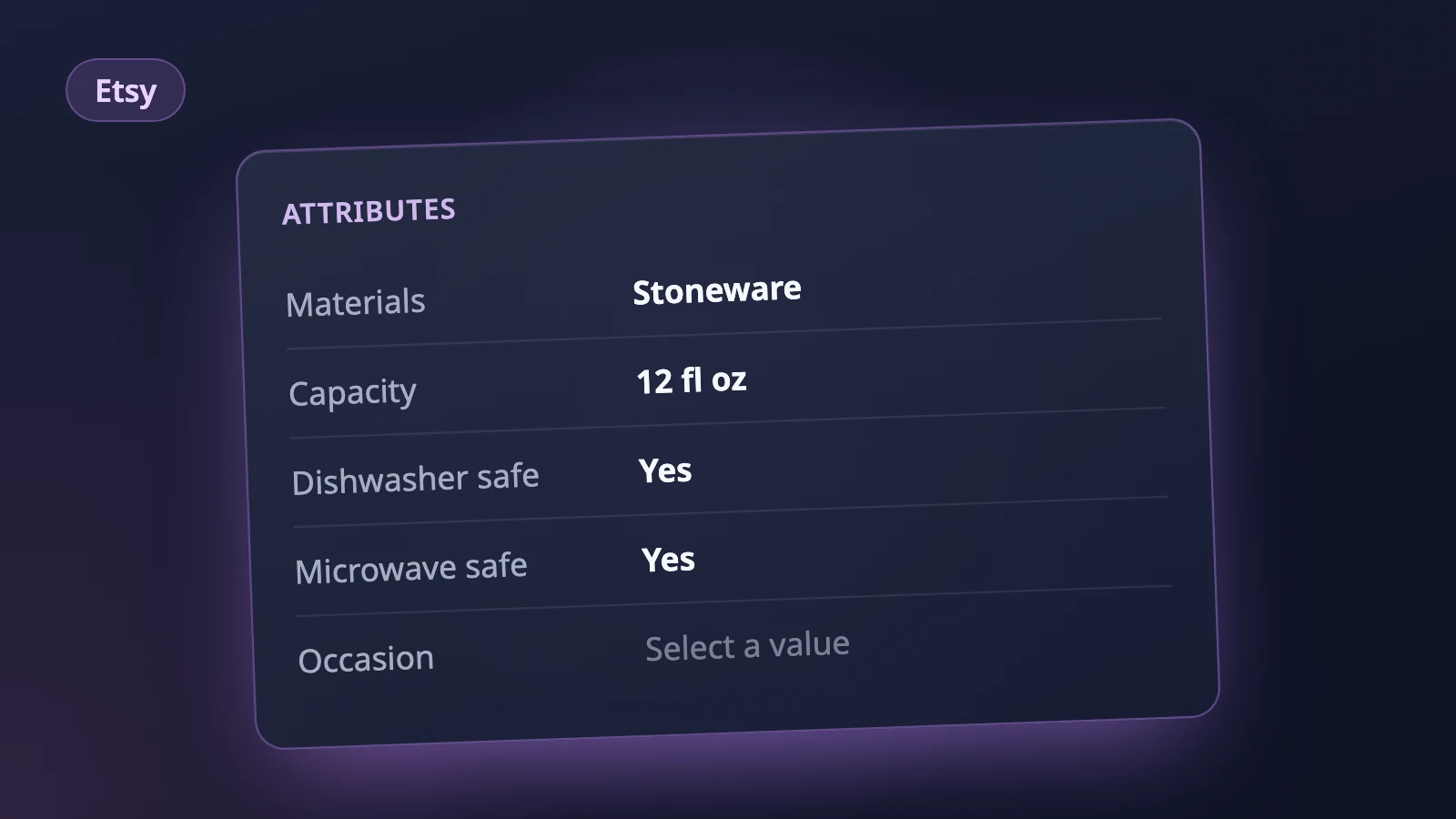
For example, when we checked the Mugs category, the form offered attributes such as Materials, Capacity, Dishwasher safe, Microwave safe, Handle, Occasion and Holiday. A hair tie gets a different, shorter set.
This is why the category comes first. If you change the category later, look at the attributes again: the ones you filled in may no longer exist, and new ones may have appeared.
How to fill them in
Describe the item, not how it might be used
Etsy's handbook draws the line clearly: attributes describe what a product is, not how someone might use it. Its example is the holiday attribute. Father's Day fits a Father's Day card, made for that holiday. It does not fit a wallet just because a wallet makes a good Father's Day present; that kind of gift appeal belongs in your tags.
The same goes for Occasion. Leave it empty on a mug that suits any day of the year. Set it on a mug that has Happy Birthday glazed on the side.
Pick the closest option when yours is missing
The lists are fixed, so your exact word may not be there. Etsy's help center suggests choosing the closest option. For a lemon-colored item, that means Yellow for the Color attribute. If the specific word matters to buyers, put it in a multi-word tag such as lemon yellow mug. A tag that only says yellow repeats the attribute and adds nothing.
Treat materials as a claim
Choosing a material is a statement about your item. In its section on Materials and Material features, Etsy's help center says selecting a Material or a Material feature is a claim that it accurately describes the item, is not misleading and is supported by sufficient information. It also asks you to explain in the description how the selection applies, such as the item's full material composition, and to keep records that back it up. Etsy does not verify the attributes sellers choose, so the responsibility is yours. If you are not sure whether a glaze is food safe or a metal is sterling, don't select it until you know.
Measure, don't estimate
Number attributes like capacity, height or width should be measured, in the unit you normally use. For capacity, the usual convention is to measure to the brim. A mug listed at 12 fl oz holds that when filled to the top; filled to a level you can carry without spilling, it holds closer to 10 oz. If that difference matters for your item, say so in the description.
Skip what does not apply
An empty attribute is better than a wrong one. Mugs with metallic trim usually can't go in the microwave unless the maker says they can. A shopper who filters for Microwave safe and gets a mug with gold luster trim will not trust the rest of the listing.
A worked example
Here is how the attributes might look for a hand-thrown stoneware mug:
| Attribute | Value | Why |
|---|---|---|
| Materials | Stoneware | What the clay is |
| Capacity | 12 fl oz | Measured to the brim |
| Dishwasher safe | Yes | True of this glaze |
| Microwave safe | Yes | No metallic trim |
| Occasion | (empty) | It is an everyday mug |
| Holiday | (empty) | Nothing seasonal about it |
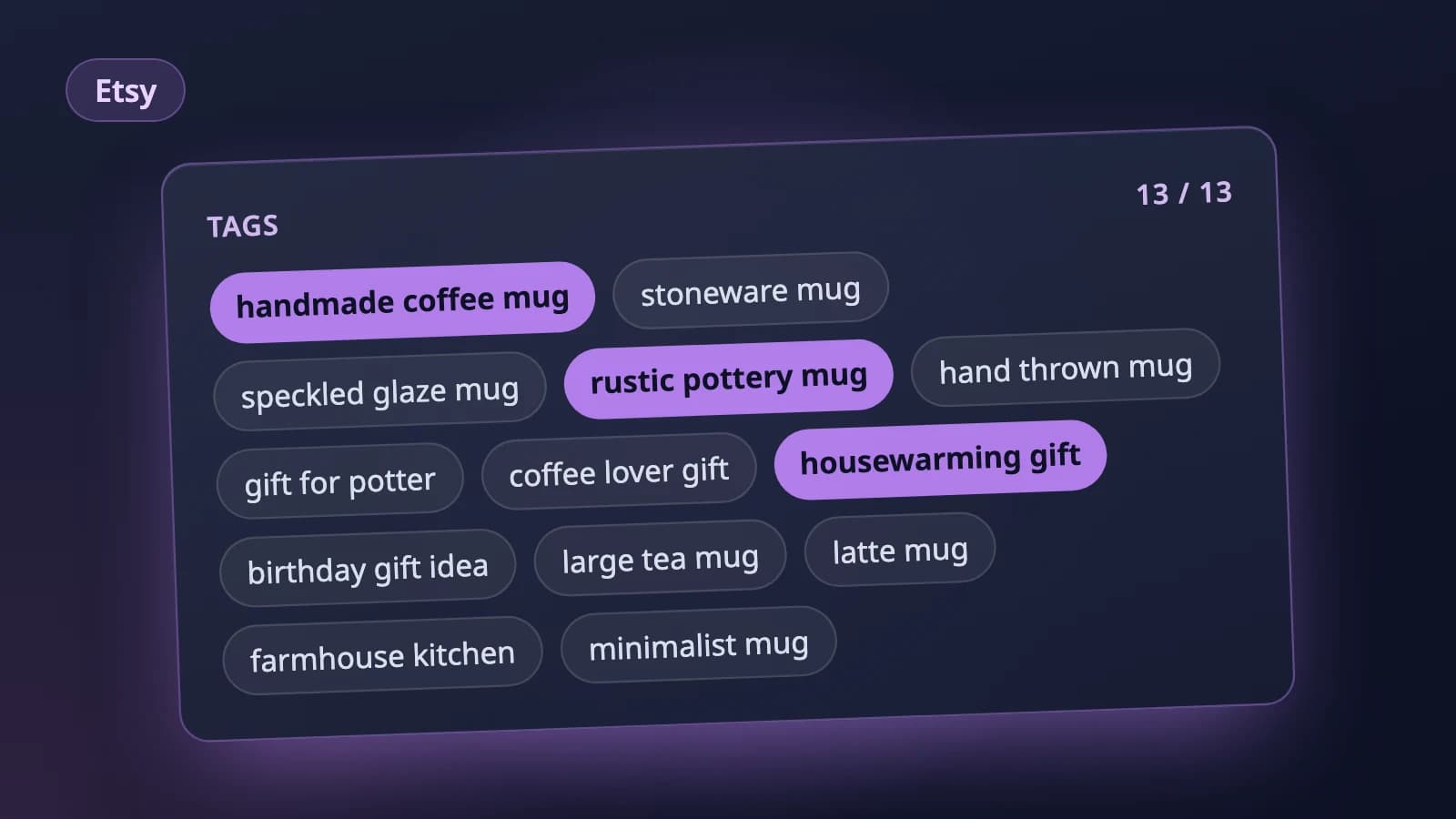
With those set, the 13 tags are free for phrases a buyer would actually type: speckled glaze mug, large tea mug, gift for potter, rather than stoneware and mug again.
A checklist before you publish
- The category is right, and you looked at its attributes after choosing it.
- You worked through the Attributes section under Item options.
- Every attribute that is true is filled in.
- Occasion and holiday are set only if the item itself is for that occasion.
- Materials are ones you can stand behind.
- Measurements were measured, not guessed.
- No tag just repeats an attribute.
Where Holgo fits
Holgo's Etsy listing AI works in the same order. It chooses the category from Etsy's real category tree first, then fills in that category's attributes using Etsy's own option names, and leaves empty whatever the photos cannot settle. The tags it suggests skip anything that only repeats your category or attributes, so every field stays yours to check before the listing goes live.
Let Holgo write the first draft
Upload photos of an item and Holgo writes the title, description and the details Etsy asks for. Free credits to start, no store connection and no card.
Sources
The marketplace rules in this guide come from these pages.